Political Performances of Latinidad (Latinness): Ending Hispanic Heritage Month w/Rosie Perez & Stephen Colbert


Esteban Colberto Reporto Gigante (a faux Sábado Gigante by no-holds-barred Stephen Colbert)

October 15 ends the weird not-really-a-month, but-definitely-30-days-long "Hispanic Heritage Month" in the U.S. As the Latino/Hispanic (although that latter term is a weird one because it implies Spanish-speaking and the majority of "hispanics" in the U.S. don't actually speak Spanish) population continues to grow in size, careers are being made in the attempt to figure out which way this group will vote.

The first thing to say is that that very question is inaccurate. There are significant ideological and historical differences within the community that calls itself Latino and so it makes much more sense to be more precise before making prophecies.

Nevertheless, Latino identity has been much more politicized this election (the presence of Zoraida Fonalledas at the RNC and Julián Castro at the DNC are one highlight--the former was received with such a lack of "respect" that the delegates were chastised from the podium; the latter has been accused of "not really speaking Spanish"). I find it interesting that two of the prime examples that stood out from the last few weeks have been humorous, intentional hyper-exaggerations of "latinidad" (latinness) that play on media images of the loud, the opinionated, the gyrating. (I've written before on the importance of playfulness in Latin art.)


"Easier as a Latino?" Rosie Perez responds to Mitt Romney's joke about wishing he were Mexican

Posted in | Leave a comment

Chicago Tribune spellcheck fail: "Kamily debt drops to pre-recession levels"

Screengrab of Chicago Tribune's new word: Kamily

Right there, on the homepage of today's Chicago Tribune. Let's see how long it takes before they realize/fix this error.

Posted in | Leave a comment

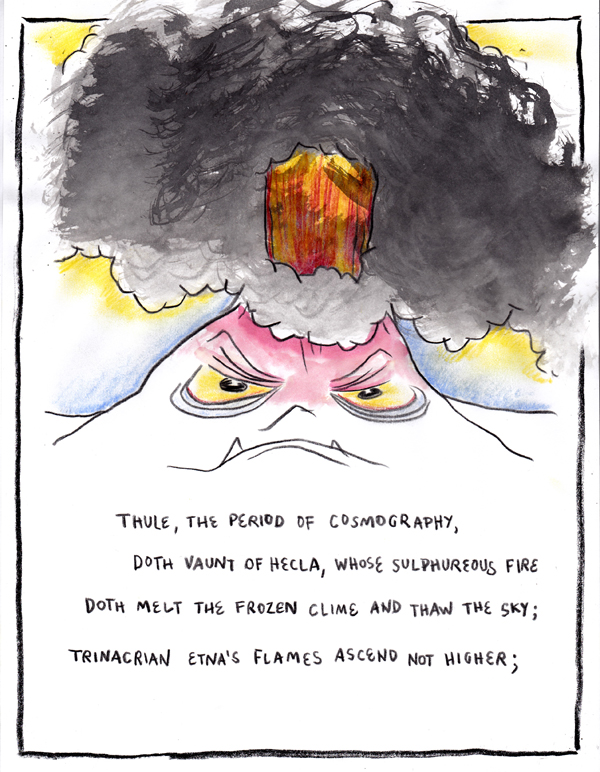
Weelkes madrigal and Novak's illustration of "Thule, the period of cosmography."

John Novak's illustration of Thule, the period of cosmography at the Paris Review

Things that go well together:

A 16th century English composer puts to tune a poem about wonder and the edge of the world.

A 21st century illustrator sketches visions of volcanic eruptions and traveling merchants from Spain who've encountered wonder at the edge of their known world.


The Poem:

Thule, the period of cosmography,
Doth vaunt of Hecla, whose sulphureous fire
Doth melt the frozen clime and thaw the sky;
Trinacrian Etna's flames ascend not higher:
These things seem wondrous, yet more wondrous I,
Whose heart with fear doth freeze, with love doth fry.

The Andalusian merchant, that returns
Laden with cochineal and china dishes,
Reports in Spain how strangely Fogo burns
Amidst an ocean full of flying fishes:
These things seem wondrous, yet more wondrous I,
Whose heart with fear doth freeze, with love doth fry. 

Posted in , , | Leave a comment

Remembering Neil Smith (1954-2012)

UPDATE: For updates on services and a chance to share your memories of Neil, see the Center for Place, Culture, and Politics at the CUNY Graduate Center.

Neil Smith at the American Association of Geography annual meeting in 2011.

Neil Smith, a Marxist geographer who found himself at home in an anthropology department, passed away early this morning. His sudden and unexpected passing leaves many of us in a lurch and I'm sure that there are many reflections and in memoria to come as the many people he touched try to make sense of his far-reaching legacy. (See "Uneven Development" (available free! online) "Uneven Development Redux")

Neil will be remembered as a firebrand who minced no words in his critiques and left no sacred cow unchallenged in his contributions to geography, history, anthropology, and more. But here I want to reflect on Neil Smith as someone who was very fortunate to be his student. I always found Neil, in spite of his fiery reputation, to have a quiet manner about him.

On a fall day, much like today, over a pint of stout (much like the one I'm enjoying now), Neil and I discussed a brief paper I'd turned in, which dealt with my earliest forays into a little studied part of the world: the Triple Frontier.


His reiterated his comment, "This sounds like the prelude to a dissertation..." and that was all the encouragement it took. It was in his class that I came across my dissertation topic.

Our "Endgame of Globalization" seminar that semester quickly became a course where the students had free rein to explore whatever interested us. He was as much a participant as he was a facilitator. Neil's seminal argument about the production of scale is the kind of productive and provocative idea grad students love to pick up and incorporate in their own work. He was never proprietary or fearful of what his ideas might become in the hands of his students. His fearless generosity with his ideas made him an excellent teacher.


An Irish stout
An American oatmeal stout

Neil, I'm really thankful to have been your student. Oh, and that plant you asked me to revive never really made it, sorry!

Posted in , | Leave a comment

Mate and Vino: Argentina's Two Excellent Beverages

Fun to write and even more fun to research: I have a new article on Slate about yerba mate and wine, Argentina's two signature beverages.

Location, Libation, Libation

A tale of two quintessential Argentine beverages: wine and yerba mate.


Posted in , , , | Leave a comment

A Different Perspective on the Triple Frontier/Triple Frontera: Business, not Ideology.

I have a new piece that just came out in Foreign Affairs:

Trouble on the Triple Frontier

The Lawless Border Where Argentina, Brazil, and Paraguay Meet

Posted in , , , , | Leave a comment

Embracing the Alien: Sci-Fi & Fantasy in Mexican Art


Pedro Meyer: detail from Batman and the Religious Procession (1991). A religious parade in Oaxaca
Something quite surprising lurks amid the sculpture and visual art showcased by the National Museum of Mexican Art in Chicago: the repeated incorporation of science fiction and fantasy themes. The museum has a rich collection, worth returning to several times, but on my first visit this weekend I was struck by the willingness of Mexican and Mexican-American artists to use sci-fi and fantasy motifs in serious pieces. And yet, there was something unflinchingly playful about how these were wielded.

Laura Molina: Amor Alien/Amor extraterrestre (2004). An unmistakable reinterpretation of “The Legend of the Volcanoes” of Mexican myth.
 
Why is there this ease with a cosmic vocabulary or fantastic backdrop when interpreting or reinterpreting daily life? As you can see from the pictures below (taken on an old smart-phone, sorry), the use of sci-fi and fantasy is quite self-conscious--but without being cynically ironic in a hipster way or overly precious and kitsch. I love the mixture of play, earnestness, and satire.

I have two theories.


Ignacio Montano: details from Assembling Energy Panels from the London Complex at Preference, Mars/Montando paneles solares del complejo de Londres de preferencia, Marte (1990). Floating astronauts with oxygen-packs at the Mars base—Just to be clear, this hasn’t happened, yet.
The Cosmic Race (la raza cósmica)

Deeply embedded in national imagery in Mexico is the concept of the "Cosmic Race." This is the idea, famously stated by Mexican statesman and philosopher José Vasconcelos in 1925, that the mix of European, Native American, and African races and cultures in Mexico would be the way of the future. He called this mixture la raza cósmica.

Now, I'm not claiming that the artists below ascribe to any of that. MY POINT IS THAT THE USE OF THE OTHERWORLDLY IS MAINSTREAM. This is not (merely) the domain of nerds and geeks.

Alfredo Arreguin: Ballads from My Land/Corridos de mi tierra (2004). Emiliano Zapata and the Virgin de Guadalupe, as well as other iconic figures of Mexican history and legend fill the night sky.
Reverse Gravity

Or, put more simply, satire. There’s something of satire in these appropriations of images originally created in the U.S. By treating Batman and Mars and the infamous sexy Green Ladies from Star Trek as supremely serious (when all involved are aware that there’s something playful about them), a critical inversion takes place. The somberness, the gravity of these incorporations veers towards the ridiculous, the way someone donning a top hat and tails (in a non-ironic way) to purchase stamps at a post office would strike us as entirely ridiculous. (Or the way this scene in Tombstone is the best ever.) And perhaps that’s the point.

Maybe by treating sci-fi and fantasy imagery as real, these artists (and I’m counting the young boy carrying the Batman saint as an artist) are, through gentle (and admiring) ridicule, taking the self-important cultural production of the U.S. down a notch. This is especially poignant given how the highly-problematic term “alien” is used by some people to describe things (and people) Mexican.

Pedro Meyer: Batman and the Religious Procession (1991)

Ignacio Montano: Assembling Energy Panels from the London Complex at Preference, Mars/Montando paneles solares del complejo de Londres de preferencia, Marte (1990).


Posted in , , , , , | 2 Comments

Search

Swedish Greys - a WordPress theme from Nordic Themepark. Converted by LiteThemes.com.