Showing posts with label Food. Show all posts

A Dominican Quest in Chicago: A guide to viandas

My Search for Viandas (A guide to what they are!)

Germania, my lovely grandmother, came to the States from the Dominican Republic in the '60s. She was an amazing cook and from her I learned how to make the Sancocho, a traditional Dominican stew featuring an assortment of viandas and meats. The thing about a Sancocho is that it's a dish meant to be shared with the family plus the neighbors plus the kid from down the block who always hangs out with the neighbor's son plus whoever else happens to be walking by. There's no such thing as a "four portion" Sancocho. Which is why I've decided to make one for some of my students.

Success?
Chicago is a mecca for tremendous Mexican cuisine (see New Rebozo—quite possibly the best Mexican food I've had outside of Mexico and certainly worlds better than anything one can find in New York—the chef/owner features 18 kinds of mole) but when it comes to the Spanish Caribbean, not so much. The real trick is the viandas, the starchy vegetables that form the base of the stew. And after six months of looking for these in various supermarkets, desperation has set in.

So, given the sad dearth of Dominican and Cuban ingredients in ordinary grocery stores, I set out on a quest (based on the recommendation of a Puerto Rican employee at Whole Foods) to find the famed Armitage Produce on the westside of Chicago…

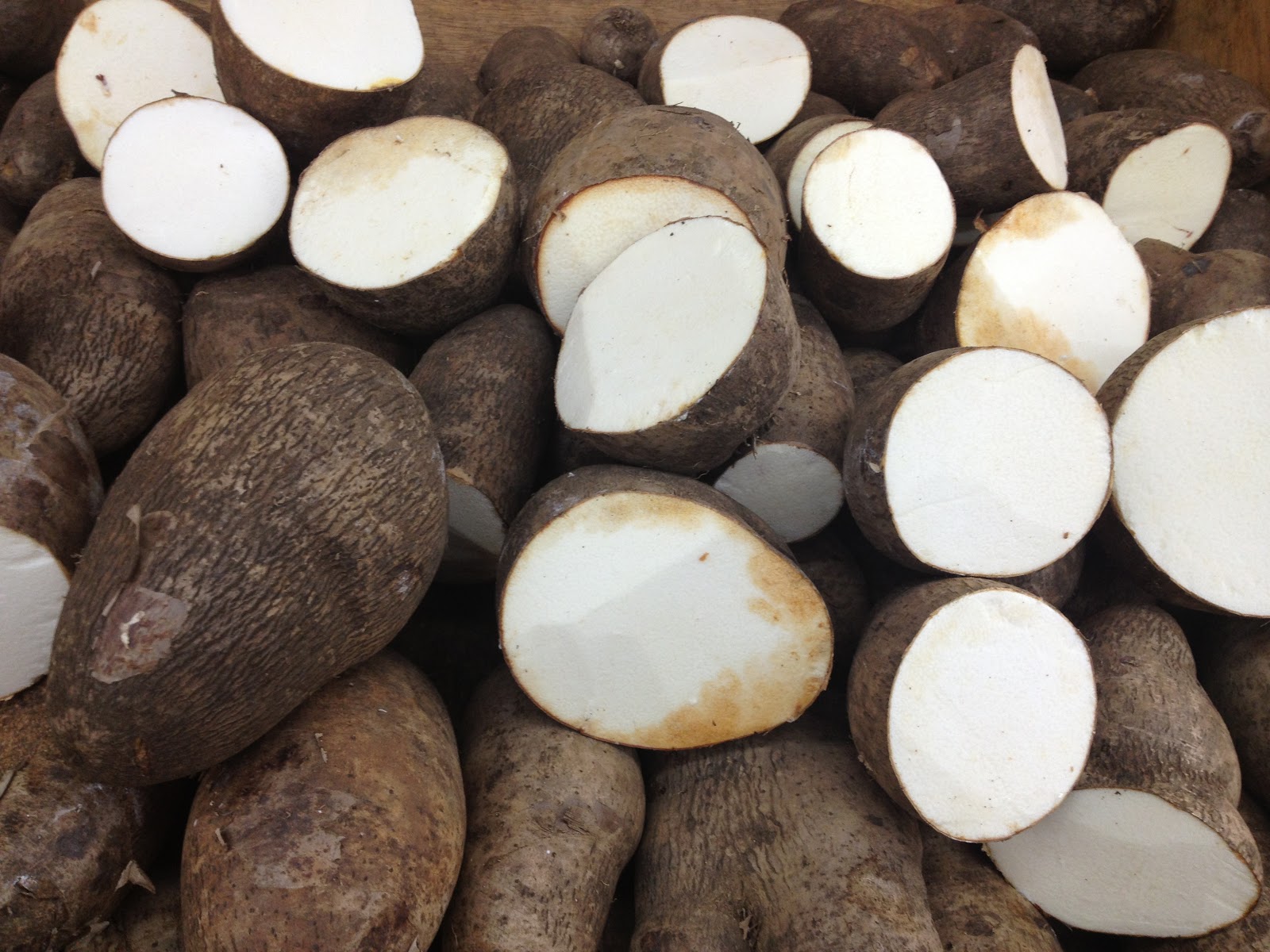
Success! Behold, a surfeit of malanga!

Malanga

Ñame (the true yam)


As you can see, people have split the ñame in half—in this case, the employees themselves. This is to verify that the root is good (people also do that with the malanga and yuca). One elderly gentleman, who grumbled about the mediocre size of the batata we combed through, warned me against trusting the quality of the root from the outside.

Posted in , , , , | Leave a comment

Great Things Happening in Harlem

I live in and love Harlem. (Yes, it's the front line of gentrification and affords a complicated vantage point on social and economic issues in New York and the U.S.) There are so many wonderful things to try and do north of 110th Street, but people who might not live in the neighborhood might not know where and when these wonderful things happen. (An excellent source for more information beyond just this post is Harlem Bespoke.)

Daytime Suggested Itinerary of Awesomeness:
1. Saturday brunch at any of the excellent restaurants mentioned below;
2. Followed by a stroll past the original Red Rooster location, for a sense of Harlem lore (138th and Adam Clayton Powell aka 7th Avenue, See here.);
3. Then, a stop at the north end of Marcus Garvey/Mount Morris Park for fresh fruit at the farmer's market (Saturdays until November, ends at 3:30pm). Fun Fact: the park's name was changed in the 70s to Marcus Garvey Park by a politician looking to curry favor in the district; it didn't take and the locals still insist upon calling it by its older name, Mount Morris Park;
4. And, finally, sitting at one of the benches in the park to listen to the drumming circle that gathers every Saturday and plays for hours.

Nighttime Suggested Itinerary of Awesomeness:
(aka A few of the many excellent restaurants in the neighborhood):

Chez Lucienne on Lenox Avenue (aka 6th Avenue), just north of 125th Street.
This French bistro is run by Burkinabés (people from Burkina Faso) and has interesting dinner or drink themes every night. Saturdays feature live African bands. Expect good French wines, mussels, French fries, steak au poivre, etc. They have sidewalk dining when the weather is nice (as it is these days), which is great people watching.

Mobay on 125th, a few steeps east of Lenox Avenue (aka 6th Avenue).
Caribbean fusion food and drink, festively decorated with hanging lanterns and lights both in and outside. Live music many nights. Jerk chicken, coconut encrusted shrimp, signature rum punch cocktails. The food is amazing.

Native on Lenox Avenue, just north of 118th.
Creative reinterpretations of "traditional" dishes from across the world with addictive sangría. Moroccan fried chicken served with collard greens, beef short ribs braised in red wine. They also have sidewalk seating during warm nights. And did I mention the sangría?

Red Rooster on Lenox Avenue (aka 6th Avenue) just north of 125th.
Marcus Samuelsson's Harlem spot is in the spotlight as New York's latest haute cuisine. Its fame is deserved. They have a happy hour before 7pm on Mondays through Thursdays, which is an excellent way to sample the signature cocktails (note the infused bourbons that line the back of the bar). My favorite is the Earl of Harlem. Reservations are hard to get, so why not just walk up, put your name down for the evening and be flexible about where they seat you? Communal tables at the bar, al fresco dining, and live music some nights.

Posted in , , , | Leave a comment

Eating Where the Cooks Eat: Critiquing Food Writing in New York

"Do you have to be white to be a food critic?"-- question I wish I had asked.
"What's the relationship food critics have to producing food? Do they cook, too?"-- question I actually asked.

The most excellent gentlemen of Gelf magazine hosted a Media Circus on Food Writers, with three of New York's (employed) food writers presenting their thoughts on a range of issues from food blogging ("Print is dead!" cried one) to food porn ("I love it!") to anonymity ("If you're made, pretend anyway!"). The man in the audience wearing a devil mask (and wig), who initially creeped me out, turned out to be the quite charming, and determinedly anonymous, Village Voice food critic Robert Sietsema, who was joined by Time Out New York's Gabriella Gershenson and NBC's Alex Vallis.

It was fun, but raised the question of "the new foodism"-- our attitudes about food and what food critique is. Sietsema is, apparently, unusual in the field because he reviews what one of the other critics called "authentic, fresh-off-the-boat, ethnic food." Though it's easy to criticize that unfortunate characterization, I want to make a stronger argument about why those kinds of restaurants are very much worth reviewing and eating at. The stronger argument is not about politics, it's about the practical. The people who eat there are the people who are cooking the food at the fancier restaurants being reviewed.

The people who are making the fine dining, culinary fashion-forward cuisine of New York City, the restaurants that are being reviewed and noticed by taste-making critics are not the celebrity chefs. The people who are actually doing the cooking, pulling together the recipes in the kitchens, the ones who are crafting the food of New York are the working class immigrants who eat at these local unassuming ethnic restaurants. They are bringing their sense of spices and flavorings, of how to prepare dishes. And so, to understand what's happening in the upscale restaurants that lead the way in food in the US, we need to sit at the tables of the people who cook it.

And so, my part in this endeavor will be unveiled in the near future.

Posted in , , | 1 Comment

Paraguay's idiosyncrasy identified: Cows + Ministry of Justice

Long after the workday ended (it ends at 1pm), four well-fed, healthy, unroped cows wandered onto the plaza in front of the Ministry of Justice (the Palacio de Justicia) in Asunción.


Posted in , | Leave a comment

Tableware from the Ferro-Carril Central de Paraguay (the Paraguayan railroad)

From before the War. The porcelain is made in England.


Posted in , , | 1 Comment

Tips for Asunción Living

Exchange your traveler's checks at the Banco de la Nación Argentina, which is in front of the Panteon de los Heroes. Exchange houses take a higher percentage out of your checks and the American Express office in Asunción does not do exchanges.

Bolsi Restaurant does delivery for a fee of about 6mil Guaranies... that's a little more than a dollar. (021) 491 841. Open on Sunday! No menu online, so just order the Ensalada Bolsi (chico) and add Pollo Grillé for a measly 46mil Guaranies (a little more than $9, including delivery), which is enough for two people.

Freddo's (the Argentine ice cream chain) also does delivery for the pittance of about 6mil Guaranies. One kilo of ice-cream will run you a total of 61mil Guaranies (about $12, including delivery). (021) 616 0800. Open on Sunday!

Posted in , | Leave a comment

Where to eat: Man House, Ciudad del Este's best Korean spot.


One of the benefits of living in Mos Eisley is the diversity of the cuisine. Though there are several Korean restaurants in this Paraguayan city of 300,000 (I'm more inclined to think the real population of CdE is closer to 125,000), Man House rises above them.


Not to be missed: the bulgogi is good, the pork ribs are even better, and the spicy seafood (marisco) soup (I think it's number 10 on the first page of the menu) is stellar. They serve the meat with sesame leaves for rolling (not just lettuce). Prices (which are reasonable are in dollars, but they accept guaranies, reales, and pesos--even all at once.


Open for lunch and dinner during the week. On Abay between Adriana Jara and Pai Perez.

Note: I'm trying to show the exact location via Google maps, but it has the streets either unfinished or mislabeled for this city-- in fact, they label the city Puerto Presidente Stroessner (!!!) a name not used since 1989. Wow. Bad job on this.

I give up. No Google Maps link to CdE is accurate enough.

Posted in , , , , | 1 Comment

Where to eat: Trapiche, Seafood restaurant extraordinaire in Foz do Iguaçu

Carly prepares to dive in.


Yes, you are looking at shrimp, octopus, squid, bacalao.

Satisfy your cravings for excellent seafood in Foz do Iguaçu at Trapiche. The name of the restaurant means "sugar cane mill" or "olive press," but in this border town in Brazil, it translates to "damn fine food." The shellfish fresh, the sushi quite respectable, and the caldeira of Moquequa (a stew made from coconut milk, palm oil, cilantro, onions, and seafood--a traditional dish of Bahia) was enough for at least three people (though, being a good cubinicana, I ate a share for at least two) and served with rice and pirão (yuca/mandioca/cassava farina made with the broth from the moquequa). It runs about $69 reales ($34 USD). Open for lunch Wednesday-Sunday, dinner every night of the week, and a rodizio of shellfish on weekends. Located on Deodoro across from Hotel Rafain.

Posted in , , , | 1 Comment

Stevia, Paraguay's Natural Sweetener, Makes it Big in USA

At last! Stevia, a plant whose leaves are sweet and which is native to Paraguay, has gotten approval from the FDA for use as a non-calorie sweetener and is being marketed in the USA under the names Truvia and PureVia.

The sad part of the story, of course, is that no Paraguayan company could get its act together enough to patent, develop, and market this for an external market. A couple of big multinationals had to do it. And so, no one will know that this is a plant indigenous to Paraguay, grown here, processed here, used here for years as a non-calorie sweetener that doesn't have those nasty aftertastes that Saccharin/Aspartame/Sucralose. And, of course, the financial benefits do not mostly go to this country.

Posted in , | 2 Comments

Where to eat: Michael Bock, German bakery in Asunción

On Pte Manuel Franco between Ayolas and Montevideo (micro-center), Asunción, Paraguay. Here you can get excellent breads (including many whole-grain varieties), desserts, a middling cup of coffee (par for the course in Paraguay), baked breakfast goods, and sandwiches. Open during the day (and not on weekends).

Notice the empty shelves? It's 9 in the morning and they are already selling out of delicious breads. Mostly German recipes (quarkbrot), but their ciabatta sells briskly. But fear not, through a large window you can see more being prepared. And while you sit, sipping coffee and nibling on your palma, read the local German newspaper. Note: no air-conditioning (this is a bakery, after all).


(Images by me.)

Posted in , , | 1 Comment

The Cure for Hiccups and Translated Food (Korean Bodegas)

Ana's four-week old grandson was paraded in front of me with great delight. On my third day back in Asunción I was able to reconnect with the extended clan of my former Guaraní instructor, Hermelinda. Apparently, my months spent sitting and reading have added a few pounds, something that was noted and praised. Shrug. I noticed that the little boy, with a head of hair thicker than what we'd see on a newborn, had a small wad of cotton fixed in the middle of his forehead. "In our culture," Herme explained, "we does this to cure the hiccups. What do you do?"

I'm not sure we do anything; certainly trying to frighten the baby out of hiccups, as we do to adults, is out of the question. "Do you use olive oil?" I continued. "No... just water or saliva," she answered.

My suspicion has been confirmed, if only in part. The bodega on the corner is run by Koreans. I bet the one on the following block is, too. When I asked the owner, who sat reading his Bible, where one could find good bulgogi and kimchee, he looked at me bemused and surprised. Apparently, there's no place yet that serves this, but he did give me an approving thumbs-up for knowing (and liking) something about Korea. I wonder how different it'd be down here for a Paraguayan palate (and with local ingredients). Hopefully better than the suspicious "Exquisito Plato Oriental Chop Suey" I saw at Bolsi Restaurant, which boasts (in English) of having "The best food south of Mason-Dixon."

And?

Posted in , | Leave a comment

A week's worth of food, around the world.

Here is a project I wish I'd done. Photographer Peter Menzel and writer Faith D'Aluisio's new book, Hungry Planet: What the World Eats, examines food and the effects of globalization.

Though the photos themselves speak volumes about hunger and injustice and wealth, I love that the families in them are smiling and welcoming the viewer into their homes. Also interesting to note: the presence of Coca Cola, processed foods, whole grains, the absence of protein and fat, the context of home versus refugee camp, and the size of families.

What does a weeks worth of food look like around the world?
Japan: The Ukita family of Kodaira City
Food expenditure for one week: 37,699 Yen or $317.25


Italy: The Manzo family of Sicily
Food expenditure for one week: 214.36 Euros or $260.11


Germany: The Melander family of Bargteheide
Food expenditure for one week: 375.39 Euros or $500.07


United States: The Revis family of North Carolina
Food expenditure for one week: $341.98


Mexico: The Casales family of Cuernavaca
Food expenditure for one week: 1,862.78 Mexican Pesos or $189.09


Poland: The Sobczynscy family of Konstancin-Jeziorna
Food expenditure for one week: 582.48 Zlotys or $151.27


Egypt: The Ahmed family of Cairo
Food expenditure for one week: 387.85 Egyptian Pounds or $68.53


Ecuador: The Ayme family of Tingo
Food expenditure for one week: $31.55


Bhutan: The Namgay family of Shingkhey Village
Food expenditure for one week: 224.93 ngultrum or $5.03


Chad: The Aboubakar family of Breidjing Camp
Food expenditure for one week: 685 CFA Francs or $1.23

See here for a few more photos and to read comments.

Posted in | 2 Comments

Food Riots: About Price, Not Starvation

Because the price of food has skyrocketed in the past few years (due in part to the rising transportation costs of fuel and the increased demand on staple grains that make for good biofuels as well as the increased demand for arable land), we've seen widespread food riots. In Haiti, they recently toppled a government--this is also how Baby Doc was finally forced from power in the 80s (see this exceptional work by Michel-Rolph Trouillot for more on how Duvalierism was not entirely exceptional). And things are quite bad in Somalia, though Ethiopia begs to differ.

Though we might think that food riots are about hunger and starvation, Charles Tilly's analysis of modern Europe showed that food riots are about prices and not just food scarcity. He relates stories of people taking over ships of grain and, rather than stealing it, selling it for what they think are fair prices. If we read the news items on the unrest of the past few months, while there clearly is the danger of starvation, we see repeatedly that the riots also are about rising prices and, in Somalia's case, the unwillingness of merchants to accept local currency as payment. So, there's food. It's just that the people who need it can't get it.

Posted in , | 2 Comments

Demystifying Food: How to Make a Flan

Yes, I tried my hand at recording a series of clips (first time ever!) for youtube to show people how to make flan. You can watch this for laughs or grimaces.


Posted in | 1 Comment

Not New: Rising Trend of Food Riots

Ever since states began administering the agricultural resources of their populations (like, thousands of years ago), food scarcity, hoarding, and price jacking have incited unrest. The recent upsurge in reporting about food is more than a media trend. Changes in the recent past have drastically affected the price of food, globally, and are leading towards an escalating crisis which the World Bank has declared an emergency as hundreds of millions are in danger of plunging into worse poverty.

The price of food has risen. This is chiefly because of the connection between food and fuel. With oil prices at new highs, it costs that much more to transport food and the increase is passed on to the consumer. With oil prices at new highs, alternative sources of fuel are increasingly economically viable--hence the turn to biofuels (ethanol, from corn, being the best known but there are other oilseed being grown) and so crops that could be going to feed people are being converted to fuel, decreasing the supply of food and raising the price and of course the increase is passed on to the consumer.

In the past year, the price of food in poor countries has gone up by 50%, which is why we see demonstrations in Haiti, leading to the ouster of its Prime Minister. This is also why Argentines, the world's highest per capita consumers of meat, had to subsist on pasta and pizza for weeks when farmers and ranchers halted shipments of their produce in retaliation to the government's desire to raise taxes on farmers to benefit from the financial windfall from higher profits. And this is why American farmers who've been paid money for decades to let their fields lie uncultivated are starting to use those fields for biofuels and more "traditional" crop usage.

And, to be very clear, I, like Toussaint, think of Haiti as part of Latin America.

Posted in | 1 Comment

Search

Swedish Greys - a WordPress theme from Nordic Themepark. Converted by LiteThemes.com.