Showing posts with label Art. Show all posts

Honored to participate: my poem on Lament For The Dead

Every day this summer, a community of poets, artists, and ordinary folk have chosen to lament the death of anyone killed by police or a police officer killed in the line of duty with a poem. Brooklyn-based writer Carey Wallace is curating Lament for the Dead.

Today, I added my piece to it, grieving the death of Victo Larosa III, 23, in Jacksonville, FL who died for $60 of crack and innumerable lies about what matters in life. Poetry makes us vulnerable--and I'm no poet, so I feel a bit abashed--but the issues of violence in our country are more important and worth the risk. Here it is in full.

And the first three lines:

When did we decide sixty dollars of crack
  was our thirty pieces of silver?
That we should take a life for so little.

More on Lament for the Dead's vision and purpose:

Lament for the Dead is an online community poetry project which will mark the death of every person killed by police this summer, and every police officer who loses life in the line of duty, with a poem. 

The first lie that hate tells us is that any other person is not as human as we are.
This project resists that lie by recognizing each other’s humanity, even in the most difficult places.

Posted in | Leave a comment

Committed to Art: Homenaje a Bolivia (Honoring Bolivia) at the Museo Nacional de Arte in La Paz

Detail from the last painting of the Virgin and the Trinity.


The Museo Nacional de Arte in La Paz is a stunning collection of visual art from the past five centuries. Bolivia's vast mineral wealth in colonial and early republic days is attested to in the religious and secular patronage of Renaissance, Baroque, and Impressionist (!) Bolivian art that is housed in a villa at the center of the city.


Posted in , | Leave a comment

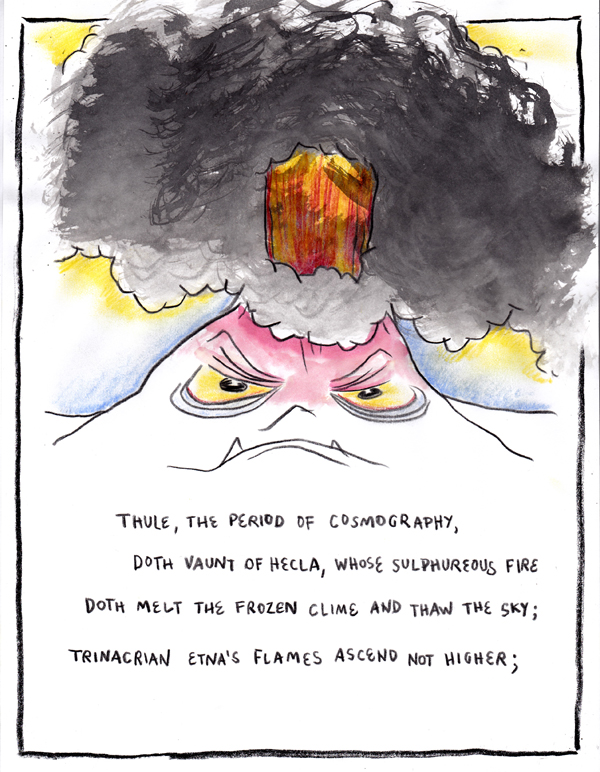
Weelkes madrigal and Novak's illustration of "Thule, the period of cosmography."

John Novak's illustration of Thule, the period of cosmography at the Paris Review

Things that go well together:

A 16th century English composer puts to tune a poem about wonder and the edge of the world.

A 21st century illustrator sketches visions of volcanic eruptions and traveling merchants from Spain who've encountered wonder at the edge of their known world.


The Poem:

Thule, the period of cosmography,
Doth vaunt of Hecla, whose sulphureous fire
Doth melt the frozen clime and thaw the sky;
Trinacrian Etna's flames ascend not higher:
These things seem wondrous, yet more wondrous I,
Whose heart with fear doth freeze, with love doth fry.

The Andalusian merchant, that returns
Laden with cochineal and china dishes,
Reports in Spain how strangely Fogo burns
Amidst an ocean full of flying fishes:
These things seem wondrous, yet more wondrous I,
Whose heart with fear doth freeze, with love doth fry. 

Posted in , , | Leave a comment

Embracing the Alien: Sci-Fi & Fantasy in Mexican Art


Pedro Meyer: detail from Batman and the Religious Procession (1991). A religious parade in Oaxaca
Something quite surprising lurks amid the sculpture and visual art showcased by the National Museum of Mexican Art in Chicago: the repeated incorporation of science fiction and fantasy themes. The museum has a rich collection, worth returning to several times, but on my first visit this weekend I was struck by the willingness of Mexican and Mexican-American artists to use sci-fi and fantasy motifs in serious pieces. And yet, there was something unflinchingly playful about how these were wielded.

Laura Molina: Amor Alien/Amor extraterrestre (2004). An unmistakable reinterpretation of “The Legend of the Volcanoes” of Mexican myth.
 
Why is there this ease with a cosmic vocabulary or fantastic backdrop when interpreting or reinterpreting daily life? As you can see from the pictures below (taken on an old smart-phone, sorry), the use of sci-fi and fantasy is quite self-conscious--but without being cynically ironic in a hipster way or overly precious and kitsch. I love the mixture of play, earnestness, and satire.

I have two theories.


Ignacio Montano: details from Assembling Energy Panels from the London Complex at Preference, Mars/Montando paneles solares del complejo de Londres de preferencia, Marte (1990). Floating astronauts with oxygen-packs at the Mars base—Just to be clear, this hasn’t happened, yet.
The Cosmic Race (la raza cósmica)

Deeply embedded in national imagery in Mexico is the concept of the "Cosmic Race." This is the idea, famously stated by Mexican statesman and philosopher José Vasconcelos in 1925, that the mix of European, Native American, and African races and cultures in Mexico would be the way of the future. He called this mixture la raza cósmica.

Now, I'm not claiming that the artists below ascribe to any of that. MY POINT IS THAT THE USE OF THE OTHERWORLDLY IS MAINSTREAM. This is not (merely) the domain of nerds and geeks.

Alfredo Arreguin: Ballads from My Land/Corridos de mi tierra (2004). Emiliano Zapata and the Virgin de Guadalupe, as well as other iconic figures of Mexican history and legend fill the night sky.
Reverse Gravity

Or, put more simply, satire. There’s something of satire in these appropriations of images originally created in the U.S. By treating Batman and Mars and the infamous sexy Green Ladies from Star Trek as supremely serious (when all involved are aware that there’s something playful about them), a critical inversion takes place. The somberness, the gravity of these incorporations veers towards the ridiculous, the way someone donning a top hat and tails (in a non-ironic way) to purchase stamps at a post office would strike us as entirely ridiculous. (Or the way this scene in Tombstone is the best ever.) And perhaps that’s the point.

Maybe by treating sci-fi and fantasy imagery as real, these artists (and I’m counting the young boy carrying the Batman saint as an artist) are, through gentle (and admiring) ridicule, taking the self-important cultural production of the U.S. down a notch. This is especially poignant given how the highly-problematic term “alien” is used by some people to describe things (and people) Mexican.

Pedro Meyer: Batman and the Religious Procession (1991)

Ignacio Montano: Assembling Energy Panels from the London Complex at Preference, Mars/Montando paneles solares del complejo de Londres de preferencia, Marte (1990).


Posted in , , , , , | 2 Comments

Documentary Available Online: "Dios Bendiga el Paraguay"--the chronicle of Fernando Lugo's unprecedented election

Dios Bendiga el Paraguay is a documentary made by a group of filmmakers as they followed an unlikely candidate, a Bishop from a rural region of Paraguay, win the dramatic presidential election in 2008. Fernando Lugo defeated the Colorado Party candidate and ended one-party rule in April 2008. This is the story of Paraguay's first leftist president and first peaceful transition of rule in the country's history, made all the more incredibly because the Colorado Party had access to all the wealth and resources of the Paraguayan state and, in spite of massive electoral fraud, Lugo still won.

It's in Spanish (and Guaraní that's been subtitled).


DIOS BENDIGA EL PARAGUAY from Documental Paraguay on Vimeo.

Posted in , , | Leave a comment

Nature Sacrificed: Saltos del Guairá/Sete Quedas (Guairá Waterfalls) in 1936

The Guairá Falls, on the Paraná River between Paraguay and Brazil, were flooded in the early 1980s as part of the construction of Itaipú Hydroelectric Dam, their beauty sacrificed to create energy. (They're sometimes called "Guaíra" in Brazil).

This is a fantastic video from 1936 (!) that gives a sense of their majesty. Notice the couple walking along the flimsy bridge (and their gaucho pants!).


Posted in , , , , | Leave a comment

Malika Zarra at Between the Seas--Liquid Roads and Flowing Melodies

Moroccan artist Malika Zarra and her band that's as worldly as she performed at the New York festival "Between the Seas" on Friday. She sang in at least four languages--Berber, Arabic, French, and English--songs that ranged from traditional Berber ballades to poetry she herself wrote. And they took the time to introduce the audience to musical styles associated with various Sufi "brotherhoods" in Morocco. This video does not do the evening justice; it's just to tempt you to go to her website (above).


Between the Seas is a new "Mediterranean world" art festival in New York City. It was begun by Aktina Stathaki, Ph.D. (a Greek dancer) with the sensibility that the Mediterranean Sea is itself a region of shared cultural resonances. So, instead of thinking "North Africa" or "Southern Europe" or "the Levant," the festival hearkens back to the conception of water and not landmasses as being the defining cultural or regional (or political) unit. Though now we think of social units in terms of land ("Europe," "North America"), for most of recorded history, people thought in terms of the rivers and seas that linked them. And so we had the Nile, the Mediterranean, the Atlantic. It's cool to see art and cultural expression once more being interpreted in this older vein.

Posted in , , | Leave a comment

MEVES: the chilling virtual museum of "Memory and Truth about Stronismo"

A torture device (la picaña--the cattle prod, used to deliver electric shock to the victim's genitalia).

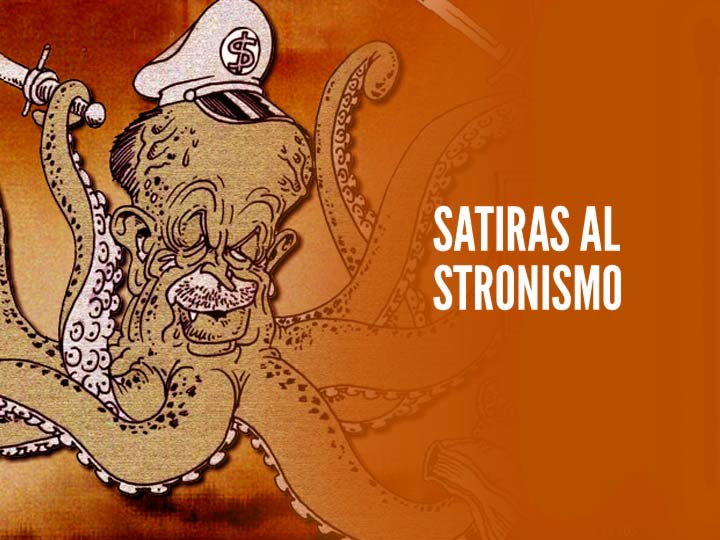
"Satire of Stronismo"-- Alfredo Stroessner as an octopus with tentacles reaching into every part of the state and of person life.


MEVES, the online museum of Memoria y Verdad sobre el Stronismo, has just launched a brilliant website that is well worth visiting. General Alfredo Stroessner orchestrated a coup (golpe) in 1954 that brought him to power in Paraguay. He ruled for the next 35 years, renewing a 90-day "state of siege" every three months (although he'd lift it for one day--election day--so that he could be re-elected president every five years) until the late 80s.

"Stronismo" is the philosophy and style of government of Stroessner and featured heavy persecution of all kinds of opposition under the guise of anti-communism. Not only was communism made illegal (punishable by 20 years incarceration), but anyone opposed to Stroessner's regime was labeled a communist, including members of Stroessner's own Colorado Party who disagreed with him. 90% of all political prisoners were tortured.

Key to all of this was a sophisticated Intelligence Service run out of the Ministry of the Interior, which spied on, detained, tortured, executed, and disappeared tens of thousands of Paraguayans (and not a few foreigners) from 1954-1989. This period is referred to as the "terror" and is documented in great detail by that very regime in its police/investigation/military archives known as the "Archive of Terror" (Archivo del Terror, which was unearthed in 1992). In addition to forced confessions, psychiatric evaluations of prisoners, and confiscated mail, it also contains thousands of reports from secret informants and even (unheeded) requests from the BDR to help locate Nazi war criminal Josef Mengele.

MEVES chronicles the deterioration of human rights during the Stroessner regime.

Posted in , , , , | Leave a comment

"Songs About Books" by Carey Wallace... a cd that celebrates literature

CAREY WALLACE | songs about books from Zeke Anders on Vimeo.

As part of a celebration of the launch of the paperback edition of The Blind Contessa's New Machine.

Posted in , , | Leave a comment

Murder, Silver, 17th Century Peru: Novelist Annamaria Alfieri visits Wellesley


Annamaria Alfieri will be available for book signing and wonderful conversation at the Main Library in Wellesley, MA tomorrow. Her new book, City of Silver, is about a murder at Potosí and is already garnering praise. I had the good fortune to meet her today at the New York Public Library--she's already working on her next novel... one about Paraguay.

Thursday, March 4
7:00 pm
Wakelin Room
Main Library, Wellesley Free Library
530 Washington Street

Posted in , | Leave a comment

Tableware from the Ferro-Carril Central de Paraguay (the Paraguayan railroad)

From before the War. The porcelain is made in England.


Posted in , , | 1 Comment

Prize-worthy ad: Personal plays on Paraguay's win over Argentina, loss of the War of the Triple Alliance

Print image from brilliant Personal ad. Source ABC Color

Paraguay has a reputation for being remote and so when I try to convey, particularly to scholars of Latin America, what Paraguay is like, I settle on two points: the use of Guaraní and the War of the Triple Alliance. Paraguay is really a bilingual country where the usage of Guaraní pervades all daily interactions--more people speak only Guaraní than only Spanish. And the majority of that indigenous language's speakers are not themselves Native Americans.

Next, the War of the Triple Alliance (1865-1870) is ever-present in Paraguayan memory. This was lost by Paraguay to the combined forces of Argentina, Brazil, and Uruguay-- Paraguay lost nearly half its territory, 90% of its male population, and around 50% of its entire population. This war is mentioned every day in the newspapers, any time when people discuss social ills (poverty, inequality, land issues)-- the important national holiday "Día del niño" (where you give kids easter-like baskets and toys) on Aug 16 commemorates the slaughter of pre-adolescent Paraguayan boys by Argentine troops in a battle towards the end of the war. This is Paraguay's holocaust, ever-present.

And so when Paraguay beat Argentina last week at soccer, it was seen in the context of that War. Need proof? Look at this ad for Personal, a Paraguayan cellphone company, featuring Salvador Cabañas (who we call gordinho, in all affection), the dude who set up Nelson Haedo's goal, and quite possibly the most likeable dude on the team. As he rallies his troops to victory in South Africa, the iconography is all about the War of the Triple Alliance and Mariscal Solano López who led his country into war and "murió con su patria" (died with his fatherland). All the right notes are hit--this ad should win a prize for cultural contextual excellence.


Even the title of the ad--Heroes--invokes the common term for the participants of that war.

Posted in , , , , | Leave a comment

Uroš Dojčinović, Serbian classical guitarist, performs in Paraguay.

Uroš Dojčinović is the first Serbian guitarist to ever perform in Paraguay. Last night, his concert of compositions and folk melody arrangements from around the world was to a packed audience at the Centro Cultural de España Juan de Salazar. The program included pieces by Agustín Barrios Mangoré (the Paraguayan composer/guitarist whose work Dojčinović recorded for the first time in Serbia), Villa Lobos, Tárrega, Cottin, Lebedew, Dojčinović himself, as well as works from Malta, Egypt, China.

It was amazing how one instrument, tuned a bit differently for different pieces, could effectively capture such different musical styles. (Yes, I used the word "different" three times in that sentence. Oh, well.) Also cool were variations on strumming, sliding, plucking, playing with the left hand on the neck, tapping and knocking on the wood.

The video I've taken is of three pieces: the first by Mangoré, the latter two by Dojčinović.


Posted in , , | 1 Comment

Paraguay's Jesuit Missions: Santa Trinidad & Jesus

This is what Paraguay's Jesuit reducciones look like. (All images by me.) Go here for details of how to visit them.


Posted in , | Leave a comment

Bad Manners: Roa Bastos' opened mail, found in a secret police file.

photo by me

Whatever was in this envelope, sent to Augusto Roa Bastos from Costa Rica sometime in the 1970s, probably never made it to the recipient since the Paraguayan police intercepted and opened and read and then filed it away in a secret archive that was discovered in 1992. It's been separated from the envelope; I couldn't find it this morning. The envelope was nestled in-between personal letters belonging to people whose names I wouldn't recognize, all confiscated and read and filed away by the military government in its attempt to surveille the whole population. The letters are a bit "disappointing"--sentimental accounts of daily life and declarations of affection. Nothing politically seamy.

Posted in , , | Leave a comment

(from an email) Yo, el Supremo. Paraguay's take on Bastos, Francia, and Stroessner

I'm having (what I hope is) an interesting email exchange about Bastos' masterwork Yo, el Supremo (1974) and Paraguay and thought, hey, why not post it? Gaspar Francia is the first dictator of Paraguay after independence (early 1800s) who closed the borders and prohibited contact with the outside world... For this, he got criticized by his contemporaries for being totally insane, but praised by later generations as one who was committed to Paraguayan independence. Bastos wrote a book about Francia but it was seen (and intended) as a thinly veiled critique of the Stroessner dictatorship under which Bastos was living in 20th century Paraguay.

Here's the question:
I run a tiny book club in ... and wanted to ask someone in Paraguay how important is Augusto Roa Bastos' I, The Supreme is there. Do you hear Paraguayans mention José Gaspar Rodríguez de Francia y Velasco very often? What is the conventional wisdom on the book? I am under the impression that 'Dr. Francia' remains a respected figure there, but the book doesn't show him in a very admirable light...


Here's my answer:
Thanks for emailing. Yo, el Supremo is an important work in Paraguay and Bastos is a figure who, though dead, has left his mark on the country. But, notice how "important" and "mark" don't necessarily mean "well-liked" or "popular." There are super cool cultural centers named after Bastos and Yo, el Supremo is in every bookstore (even the super tiny shacks on the sidewalks that seem to specialize in porn).

But, Paraguayans are very nationalistic and the figure of Francia, as you've said, is viewed very positively ("when a couple got married, they got a little piece of land and a pig and some seed from the state" a union leader once told me of Francia's reign). And so, Bastos' critique of Francia is controversial. I've had people take great pains to explain to me that the historical Francia and the Bastos's figure are very different and that I shouldn't confuse literature with history.

What was even more surprising to me was the way people have defended Stroessner (who Francia was a stand-in for in that book). And I mean ordinary people (not just those who have an interest in the conservative regime) who were all "some people say he's a 'dictator' but he was the president" and "some people say some people in his government committed torture, but I don't know anything of that."

Um... I hope this is a helpful email :) I'm reading it against the research I'm conducting and so it's cool to even get a chance to chat about it.


Posted in , | 1 Comment

Olvidoteca-- the library of forgotten books.

As I know well, people often leave things behind as they scurry to the airport or train station. Conde Duque, a hotel in Madrid, has transformed this into a literary project: a library (biblioteca) of books left accidentally by patrons.

Posted in | Leave a comment

Fringe Art? Blu, street art in Buenos Aires // Mawatres in Spain

I think street art, with the way it uses public space and is constrained by surfaces the artist cannot control (a dented pole, an uneven brick wall already layered with half stuck sheets of paper and old peeling paint), is both fascinating and beautiful and incredibly innovative.

Muto, a project by Italian street artist Blu, submits animation to the boundaries of graffiti and the result, well, take a look:


Art is political, but while I don't know whether Blu means to, this does speak to the violent torture regime that governed Argentina during the dictatorship of the 70s and 80s.

Hat tip: Ned Batchelder's blog (via a friend's suggestion).

In other news, Mawatres, a Spanish street artist I met in New York, has a blog worth checking out, too. Here's just a sample from his fotolog.


Posted in , | 1 Comment

NYC Photo Exhibit of Fernando Lugo's Presidential Campaign

(image from Urzúa's exhibit, via ABC Color)

Beginning today, the UN auditorium will host a 60-image exposition of Rafael Urzúa's photographs taken during a two-month journey following the Lugo campaign around Paraguay as the opposition candidate successfully (seen from hindsight) made his case for the presidency.

Posted in , , | 1 Comment

Lenguapop & Paraguay's Visual Culture, A Must-See


screen grab of Lenguapop to shamelessly entice you to take a look


I don't know when I've been so excited by an online find. Paraguay's art (visual, literary, musical) is stunningly high, especially given the isolation and size of population and wealth. Lenguapop (Lenguaje Popular... translated as "popular language," but probably better, "the vernacular") calls itself "a publicity agency that offers creative solutions." But don't let that fool you, they're doing some really sophisticated creative interpretive work on the aural and visual culture of Paraguay. Their home page captures the blend of the rural and the urban in Asunción to a tee... Look out for the guys passing the tereré in the guampa.


These are from a recent project to document urban visual culture in Asunción. For more. Or.

And Como se ingenian los perros. Their blog.

And here is Ultima Hora's story on them.

Posted in , | Leave a comment

Search

Swedish Greys - a WordPress theme from Nordic Themepark. Converted by LiteThemes.com.