Showing posts with label Anthropological Musings. Show all posts

Wheaton Alumni Magazine: Sustainability: Lessons from Latin America

My latest in Wheaton's Alumni Magazine, the Faculty Voice column:

-->
 
When I tell people that I’m an anthropologist, an image of Indiana Jones, fedora-clad and bullwhip in hand, is often the first picture that comes to mind. Though I’ve never raided a lost ark or escaped a snake pit, I have seen the stunning Iguazú waterfalls depicted in the fourth film of the series. And I’ve heard stories that rival Hollywood drama from locals adept at debating energy politics.

As a cultural anthropologist, I research how people live in the world today. The core lesson I’ve learned is the importance of seeing through someone else’s eyes, not merely because we value diversity, but because it’s there we find wisdom.

I study renewable energy in Latin America, a topic I find more engrossing now than when I began my research in 2007. Yet, had I not heeded the input of an ordinary Paraguayan, I would have missed that path.

Confession: the first time I visited Itaipú Dam (the Brazilian-Paraguayan hydroelectric plant that I research), I was underwhelmed. Even though it’s the largest dam in the entire world (capable of powering 33 percent of California’s annual energy usage), Iguazú, the Argentine-Brazilian cataracts where water pounds rock so powerfully that the mist rises like smoke, eclipsed my present view of Itaipú’s concrete wall and placid reservoir.  

Then, one Paraguayan to my right murmured, “Paraguay used to have waterfalls like Iguazú.” He took my look of surprise as an invitation to continue. “But they were destroyed for that,” he added with a meaningful nod at Itaipú Dam....

For the rest of the piece, see the interactive version of the Wheaton Alumni Magazine.
 

Posted in , , , , | Leave a comment

AAA Presentation: All That Is Water: Engineering Energy Sovereignties and Electricity Nationalities


I'm delighted to be part of this excellent panel at the AAA conference this Wednesday in Chicago: Technopolitical Futures: Transformations in State and Expertise (12-4pm)

I'm giving my paper, All That Is Water: Engineering Energy Sovereignties and Electricity Nationalities, at 2:15 on Wednesday November 20 (room TBA).

My abstract: The engineers responsible for Itaipú Binational Dam were tasked with more than just churning water into electricity or spinning nature into national development. They had to find a way to give electricity, generated by the same water of the same river at the same dam, two discrete national identities as a way to defend the sovereignty of the dam's owners, Brazil and Paraguay. Designed as a juridically distinct space of exception, Itaipú has become a “state within a state,” simultaneously subordinate and exterior to the Brazilian and Paraguayan states, rescaling sovereignties and territorialities to both the regional and the subatomic. As the state rematerializes in energy policies and practices, technicians have been transformed into technocrats such that, in Itaipú, engineering is not merely a scientific endeavor but a kind of politics as a vocation. This paper explores how electrical engineers superintend political processes and, through material and symbolic entailments, bestow nationality upon the nigh immaterial—electricity—to construct energy sovereignties and a territoriality that emanates from the circulation of charge. This invisible circulation animates conceptualizations of property and value which form the basis of a wider ethic of renewable energy newly emergent in South America. Through an ethnography of the discursive and physical interventions initiated by engineers in the world's largest dam, I show how “nature” and “nation” are altered by hydroelectric statecraft, the political economic and symbolic structures that emanate from the harnessing of hydroelectric energy and gesture towards a non-fossil-fuel future where contentions over transborder water resources abound.

Posted in , , , , | Leave a comment

In The Atlantic: "Why the West Loves Sci-Fi and Fantasy"


My piece which explores why the United States is so fond of Science Fiction and Fantasy stories has just been published in The Atlantic. This comes out of a) my own deep love of both those genres and b) many invigorating conversations with my students.

Tolkien + Star Wars + Weber = my favorite things to talk about!

Posted in , | Leave a comment

A Guide: Six Steps for Writing a Scholarly Article or Paper in Grad School

Although I enjoy writing, I still find it a challenge and I’m often curious about how other writers work as they’re producing scholarship. My own technique is something that I developed in graduate school and continue tweaking even now as I’m a professor. The Six Steps I’ve listed below are the steps I go through in order to produce a draft of an article or paper—I realize that others do things differently and the key principle is to figure out and go with what works for you. You’re not doing it wrong if you’re doing it.

It feels a bit vulnerable to reveal the unfinished product, but because graduate school can be so grueling, I thought it’d be worth it to put my process out there. All the disclaimers apply: I'm an anthropologist and this is me writing ethnography, disciplinary conventions from humanities, STEM, and even other social sciences are very different. There are other sites (here and here and here and here and here) that also give great advice on the doing of graduate school and the work we're to produce.

You’ll notice two things from the start: 
1) I do a lot of pre-writing.
(I call this “writing.”) 
2) I do a lot of it by hand.
(Writing by hand does something different for my brain as I’m trying to work through ideas or pushing through a moment of “writer’s block.” Also, typing on the computer makes it oh-so-tempting to start reading my email or fret about the WHO news on the coronavirus.)

The goal here is to produce a draft (not a perfect final version) and this takes time. Interspersed with all these steps are coffee, eating, sleeping, grading, lecturing, commuting, bathing, jogging, interacting with human beings who are not my students. These steps won’t work very well the night before something is due.

STEP ONE: Initial Brainstorming [by hand!]
Main Question: What’s interesting?

To come up with an idea for a paper (or article), start with the question “What’s interesting?” What’s the data puzzle that caught you eye? What’s the question or confusion that you find intriguing?

2 examples from my own writing:

  • Why didn’t yerba mate catch on during European colonialism in the same way that coffee and tea did, since they’re all non-European products and all have a bitter taste? (This led to an article I placed with Comparative Studies in Society and History here.)
  • Something I noticed in my ethnographic field work was that there are different versions of the “origin stories” for the massive Itaipú dam construction debt (and whether it was being repaid) and these versions seem to coincide with the political and social position of the individual. Note: images I’ve included in this post are the real notes for this paper.

I actually write down questions like this in a notebook or on a pad of paper. And then I try to figure out the “why” and the “so what.”


STEP TWO: The Basics [by hand!]
Main Question: What’s going on? Why does it matter?

On a piece of paper (usually legal paper turned sideways), I’ll label four sections entitled:

  • The Issue
  • The Data
  • Theory
  • So What?

And then I’ll jot down bullet points (sometimes entire sentences) underneath each and answer the following questions:

  • The Issue: What is the issue, the main idea of this paper?
  • The Data: What data, what evidence do I have that connects to the issue? (specific documents, interviews, participant-observation)
  • Theory: What theories help explain what I’m seeing in my data?
  • So What?: Why does this matter? What can we learn from this?

In this and the next step, I’ll read new articles and books that connect with the issue and the data. I annotate as I read (and even jot down imaginary conversations with the authors): How does W account for what she has uncovered? How is X challenging the accepted way of thinking about this? What would Y ask about my findings? What would Z point out is missing from my assertions?


STEP THREE: The Set Pieces [by hand!]
Main Question: What are the major set pieces, the major components of this article?


I began in pencil, with the boxes around what I thought might be the "major set pieces" of the article, then I drew connecting arrows and annotations to my various bullet points. On another day, I used the blue pen and then, at the end, went back to pencil to try to figure out the logical flow of various sections.

On another piece of paper (see the accompanying images), write out five sections that will help you figure out what the main set pieces of the article will be. You can see that I mark up this document repeatedly… I don’t start out with Roman numerals or any kind of order. You’ll see marginalia, arrows, and different colored ink. This is me iterating through ideas and connections. I’m very opposed to starting out with a pre-determined order or hierarchy of information. In fact, that’s one of the very questions that this step is supposed to help me work out. I certainly don’t know it from the start.

Under each of the section headings I’ll write out bullet points and even entire sentences and sometimes I’ll realize that one section actually has three main components. I usually draw boxes around the section headings (you can see it on the yellow paper):


Introduction:  
  • All articles need them.

Background/History/Primer:  
  • What background does the reader need to know to be able to understand what’s interesting about the data?

The Data:  
  • In this case, since these are notes about Itaipú dam and the construction debt, my data seemed to fall into two areas: a) How the debt grew in the first place; b) How different groups interpret that story.

Theory/Literature:  
  • Writers and key bodies of literature and approaches that connect to the data. 
  • For the paper I was sketching out, the two main debates were: a) literature on hydroelectric dams; b) literature on credit/debt. I ended up focusing on the latter.

Effects/Findings/Outcomes:  
  • What has happened as a result of the data?
  • What are my major conclusions, major interpretations of the data and the theory? 
  • What is my argument for why we’re seeing the data we’re seeing? 
  • Why does this matter?

You can see that this step is several pages long and not everything that I write here ends up in the final article. Some of it ends up as fodder for other papers, because one of the main goals of this step is to really focus on the heart of this article. The question is “What is this article about? What is the story that I’m telling? What are the main components necessary to tell that story?”

Stare and stare at these set pieces and create a logical flow through them (notice the labeling of I, Ib, II, III, IIIb, IV, V).  I do this only after writing down and detailing all the components. For me, the order arises from my ideas and the data. It’s not some formula that I begin with and then fill out.


STEP FOUR: Outline [typed!]


Type up the work you’ve done, using the logical flow order and using bullet points (and complete sentences… anecdotes, formulations of the argument) for the various subsections of each. I aim for complete sentences (just because it helps me start linking ideas), but this isn’t absolutely necessary.


STEP FIVE: Iterating the Outline [by hand and typed!]


This is the back of one of these pages, where I wanted more space and was trying to think through the way different constituencies were gathering data and making their claims about the debt from Itaipú dam.
Format the narrative outline with wide margins for notes and, by hand, comment and annotate on what you’ve written. Ask:

“So what?”
“What else needs to go here?”
“What are the steps?”
“How does theory connect?”
“What’s significant?”
“Why?”
“What’s missing here? What are the gaps?”

You might retype the outline with the added commentary, print it out, and do this process again. The aim is to get to a place where you’ve commented as much as you possibly can and gotten to the point where there’s little more brainstorming that you can do to help focus the article and interpret the data.

This isn’t the moment for exciting rabbit trails into other areas of research or articles.


STEP SIX: Drafting [typed!]


After a few days of iterating through the outline, it’s time to write. I’d suggest starting at the beginning of your outline and just write the information into paragraphs. My writing goal is a minimum of 300 words a day, but when I’ve commented and iterated through the outline, I can do triple that in a few hours.

When you feel stuck or tired with writing, print it out and write additional paragraphs by hand on the back sides of the pages. Part of the reason for printing it out is sheer paranoia—in case the computer dies, I have a hard copy.

Do only minimal editing on what’s already been written because the goal is to finish an entire draft, not to perfectly polish the first three paragraphs over and over.

Once the full draft is done, you can go and ask, again “What’s missing?” “What’s out of order?” “What’s too thin?”

That's my process. Your suggestions? How to write tips Ph.D. advice academic journal article publishing publication journal peer-reviewed academic writing anthropology ethnography academia author tenure "publish or perish" peer-review doctoral program edit revise faculty
  "writing culture" "How I write"

Posted in , | 13 Comments

In Print: Surveillance and State Violence in Stroessner's Paraguay: Itaipú Hydroelectric Dam, Archive of Terror

My most recent article has been published in American Anthropologist.  I'm very grateful to the anonymous and non-anonymous (read: colleagues) reviewers who gave feedback and especially to the former editor-in-chief Tom Boellstorff who gave such detailed and synthetic input. Writing, revising, and publishing this article in AA has been such an incredibly enjoyable experience. Interested in these archives, look here.

From the "Archive of Terror" aka Centro de Documentación y Archivo para la Defensa de los Derechos Humanos in Paraguay. 

Surveillance and State Violence in Stroessner's Paraguay: Itaipú Hydroelectric Dam, Archive of Terror

Abstract: Like other dictators, Paraguay's Alfredo Stroessner staked his regime's claims to modernity on a massive hydroelectric project, Itaipú Dam. Critiques of dams tend to focus on environmental degradation caused by flooding, forced displacement of communities, and fiscal malfeasance. But Itaipú, the world's largest dam, also participated in the Stroessner regime's secret police terror apparatus. A series of formerly classified documents about Itaipú Dam show how the secret police used the dam in its security and intelligence apparatus to violently suppress any opposition. They also reveal how the opposition to the Stronato grew and mobilized around the dam. By interlacing these two threads, this historical ethnography explores “hydroelectric statecraft” in Itaipú Dam—that is, how the harnessing of the dam's resources has given rise to particular political practices and structures within Paraguay.

Posted in , , , , , , | Leave a comment

“Hispandering”: What the GOP doesn’t get about Latino (and Asian) voters


More than a week of soul-searching and grieving has passed since Obama shocked less than half the nation by winning re-election. Demographics has caught up to politics—a fact clearly evidenced in the exit polls and even in the images we saw of the two campaign election watch celebrations the night of Tuesday, November 6 (this vs this). Obama won the popular vote and the electoral college vote through a coalition of women, ethnic minorities, labor, the LGTBQ community, and young people. The GOP knows it needs to bring more people to the polls in order to win—the coalition it counted on for victory is just not wide enough.

Cue the Hispanic vote. We’ve heard numerous GOP members and conservatives muse about how to get more Hispanics to vote Republican. But, as the strategizing goes openly on in public, the GOP has misdiagnosed the problem they have in the Latino community (and, I suspect, in the Asian community).
[Hispanics] should be a natural Republican constituency: striving immigrant community, religious, Catholic, family-oriented and socially conservative (on abortion, for example). The principal reason they go Democratic is the issue of illegal immigrants. (Charles Krauthammer in the Washington Post)
More Latinos voted in this election than in any previous election and this is a growing population (half of the U.S. Census growth from 2000-2010 came from increases in the Hispanic community). We’ve already seen the numbers from this election: Romney got somewhere between 25 to 27%of the Latino vote (worse than McCain and way worse than George W. Bush in 2004, who walked away with 44%).

The Flawed GOP Solution: Immigration Reform Isn’t the Silver Bullet. Like Hannity, many conservative leaders are “evolving” on immigration. They’ve edged away from Romney’s harsh stance on “self deportation” and are trying to find a way to make immigration reform not just the province of the Democrats. This is going to be good for everyone.

But the GOP lost the Latino vote on something deeper than just immigration; they lost it on meanness. The whole Birther Controversy over Barack Obama’s citizenship, birth, and Americanness—something that has deep grassroots traction with the base—cut to the very heart of the experience of the Hispanic community in the United States. And I suspect this is also why the Asian-American community supported Obama with the same numbers. Louisiana Governor Bobby Jindal got it right today when he said, "If we want people to like us, we have to like them first."

We’ve heard for years that Barack Hussein Obama seems somehow not a “real” American. The son of an immigrant, he’s got a foreign-sounding name and there’s been a constant push to get him to prove that he was really born in the U.S. (and publicly released official documents have not staved this off). But look at the Obama story from an immigrant community’s perspective: this is a kid who had to deal with having a strange name, who came from a non-wealthy family, who worked really, really hard, got into Columbia and then got into Harvard.

Obama’s story is the immigrant’s dream. And when it’s denigrated as somehow not being “really” American, this cuts deep into the experience of families from Latin America and Asia. Hispanics, Asian-Americans, immigrant communities from everywhere have made a deeply conscious choice to be American and yet in the rhetoric from the Right, they are doubted and rejected. Immigration reform offered as a quick palliative to convince Latinos to vote GOP comes across as simplistic pandering and not a deep enough heart change. The question that the GOP faces is one of hospitality and community, not just one of policy. Without the heart change, the immigration reform smacks of insincerity.

This is what the GOP needs to change to draw Latino and Asian-American voters: to view immigrants and the children of immigrants as real Americans.


Posted in , | 2 Comments

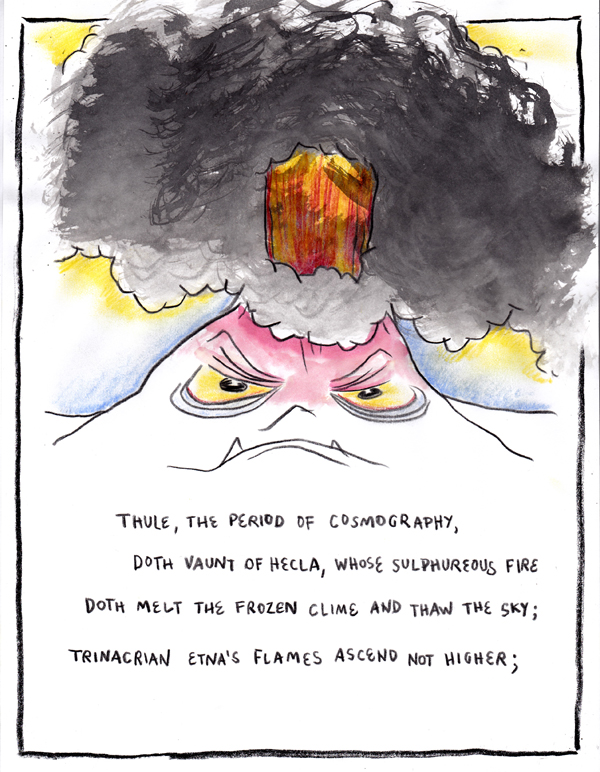
Weelkes madrigal and Novak's illustration of "Thule, the period of cosmography."

John Novak's illustration of Thule, the period of cosmography at the Paris Review

Things that go well together:

A 16th century English composer puts to tune a poem about wonder and the edge of the world.

A 21st century illustrator sketches visions of volcanic eruptions and traveling merchants from Spain who've encountered wonder at the edge of their known world.


The Poem:

Thule, the period of cosmography,
Doth vaunt of Hecla, whose sulphureous fire
Doth melt the frozen clime and thaw the sky;
Trinacrian Etna's flames ascend not higher:
These things seem wondrous, yet more wondrous I,
Whose heart with fear doth freeze, with love doth fry.

The Andalusian merchant, that returns
Laden with cochineal and china dishes,
Reports in Spain how strangely Fogo burns
Amidst an ocean full of flying fishes:
These things seem wondrous, yet more wondrous I,
Whose heart with fear doth freeze, with love doth fry. 

Posted in , , | Leave a comment

Remembering Neil Smith (1954-2012)

UPDATE: For updates on services and a chance to share your memories of Neil, see the Center for Place, Culture, and Politics at the CUNY Graduate Center.

Neil Smith at the American Association of Geography annual meeting in 2011.

Neil Smith, a Marxist geographer who found himself at home in an anthropology department, passed away early this morning. His sudden and unexpected passing leaves many of us in a lurch and I'm sure that there are many reflections and in memoria to come as the many people he touched try to make sense of his far-reaching legacy. (See "Uneven Development" (available free! online) "Uneven Development Redux")

Neil will be remembered as a firebrand who minced no words in his critiques and left no sacred cow unchallenged in his contributions to geography, history, anthropology, and more. But here I want to reflect on Neil Smith as someone who was very fortunate to be his student. I always found Neil, in spite of his fiery reputation, to have a quiet manner about him.

On a fall day, much like today, over a pint of stout (much like the one I'm enjoying now), Neil and I discussed a brief paper I'd turned in, which dealt with my earliest forays into a little studied part of the world: the Triple Frontier.


His reiterated his comment, "This sounds like the prelude to a dissertation..." and that was all the encouragement it took. It was in his class that I came across my dissertation topic.

Our "Endgame of Globalization" seminar that semester quickly became a course where the students had free rein to explore whatever interested us. He was as much a participant as he was a facilitator. Neil's seminal argument about the production of scale is the kind of productive and provocative idea grad students love to pick up and incorporate in their own work. He was never proprietary or fearful of what his ideas might become in the hands of his students. His fearless generosity with his ideas made him an excellent teacher.


An Irish stout
An American oatmeal stout

Neil, I'm really thankful to have been your student. Oh, and that plant you asked me to revive never really made it, sorry!

Posted in , | Leave a comment

Forthcoming Review Article: "Seeing and the State in Argentina, Brazil, and Cuba"

Forthcoming in the Journal of Latin American and Caribbean Anthropology:

Seeing and the State in Argentina, Brazil, and Cuba
by Christine Folch

A review of:
The Optic of the State: Visuality and Power in Argentina and Brazil. Jens Andermann, Pittsburgh: University of Pittsburgh Press, 2007. 256 pp.

Hidden Powers of State in the Cuban Imagination. Kenneth Routon, Gainesville: University of Florida Press, 2010. 204 pp.

Posted in , , , | 1 Comment

AAA Presentation in Montreal: Managing Expectations: Spectacles of Corruption, Rituals of Patronage

I'll be presenting at the Annual Meeting of the American Anthropological Association, in Montreal, as part of a panel entitled "Managers Of Things, Or What Do Managers Imagine Themselves To Be Managing?" on Friday, November 18, from 8-9:45am.

Managing Expectations: Spectacles of Corruption, Rituals of Patronage

Because of its symbolic and economic weight within Paraguay, Itaipú hydroelectric dam--the world's largest--has come to embody what its planners hoped: the physical manifestation of an all powerful state. With the recent presidential election of leftist former Bishop Fernando Lugo, a new group of technocrats and politicians appointed to the helm did not merely manage the energy potential of the dam, but through it distilled the "promise" of the Paraguayan nation--promise in the sense of commitment and of hope for the future. As the engine of the Paraguayan state apparatus, the dam stood at the nexus of an intricate patronage system that grew concomitantly with the energy production. How and what favors were asked and answered by technocrats appointed to manage electricity production--a public secret--unmasks more than just the balancing act performed by high level employees as they juggled partisan obligations, political aspirations, and social pressure to portray generosity as a hallmark of power. Rather, this gets to the heart of how the fractured and tentative "state" is constituted in Paraguay--protecting privilege through the management of resources and relationships. Campaign promises to end patronage and administer the dam's wealth to bring development clashed with entrenched models of state-to-nation obligations and the personal ambitions of a new class of political elites. This paper explores how the top managers at the dam straddled informal expectations of patronage with formal responsibilities of energy production in the midst of a push towards "transparency" thwarted and abetted by mediatic "corruption" scandals. Based on eighteen months of fieldwork among Paraguay's political elite, this paper analyzes rituals of approach and request, how Itaipú managers configured multiple vectors of obligation, and how a hydroelectric dam embodied fantasies of prosperity. Itaipú's managers explicitly described this process as a way not just to remake the dam, but as a way to remake the Paraguayan state itself.

Posted in , , , | Leave a comment

Important Paraguayan Archive (1810s-1860s) Online: Curiosities and Gems

"Supreme Dictator" Gaspar de Francia rails against John Parish Robertson
for the "height of the most barbaric and brutal piracy" in 1815.

Dr. Richard Alan White, Senior Research Fellow at the Council on Hemispheric Affairs in Washington D.C. and noted historian of Paraguay found himself in a curious, frustrating dilemma when he gave copies of very important archival documents back to Paraguay last spring. To resolve it, rather than just up the ante, he went all in.

When White was doing his dissertation research on Paraguay, he came across a valuable collection of documents housed at the University of California--the Bareiro Collection. Someone has transcribed the entire collection and pdf-ed them. In celebration of Paraguay's bicentennial earlier this year, he gave the National Archive in Asunción copies of all 5000 documents as part of an attempt to increase the Archive's resources. Almost immediately, people got ahold of the documents and bound them and sold them for up to $170. (This is more than the average monthly salary in Paraguay.)

To circumvent this, White has uploaded the entire collection to a mediafire site. This can be accessed by anyone, anywhere in the world, and reflects a commitment to putting history in the grasp of ordinary Paraguayans.

I've only begun to look through the Bareiro Collection and have already found several documents that are germane to my not-not-not-my dissertation topic (the Robertson brothers' years in Paraguay, their business dealings, their banishment by Gaspar de Francia, and their writings on the whole experience decades later). The transcriptions of hand-written entries in official record books preserves archaic [mis]spellings ("Yndios" instead of "Indios,""Gefe" instead of "Jefe") and orthographic curiosities (like the practice of writing abbreviations in a vertical manner) and even the 1814 order by which the governing body endowed "the Citizen José Gaspar de Francia with the title Supreme Dictator of the Republic...for five years" (a title which he held onto until his death in 1840).


Posted in , , | Leave a comment

On the trail of 19th century Cuban revolutionaries: Researching in Harlem's Schomburg Collection

A research tip for NY-based grad students who are interested in the Caribbean and Latin America: check out the Schomburg Center for Research in Black Culture at Lenox Avenue and 135th Street. The center houses some incredibly important collections that are relevant for Caribbeanists. Arturo Alfonso Schomburg (a Puerto Rican), after whom the center is named, amassed a collection of rare books, slave testimonies, art, etc having to do with Black history, which included (of course) the Caribbean.

Here's a gem in the collection that seems like fecund ground for a NY-based research project: the meeting minutes and bylaws of Las Dos Antillas Political Club. This was an organization that Schomburg himself helped begin in the last decade of the 1800s. It worked to raise money, medicine, and munitions for the independence movements in two of the Antilles ("Antillas" in Spanish)--as the islands of the Caribbean were known. The two Antilles were Puerto Rico and Cuba and it'd be fascinating to unravel a bit of how those revolutionary movements were supplied and shaped from the exterior. Las Dos Antillas Political Club was dissolved in 1898 (which coincided with the Spanish-American War, fought, in part, over control of these two islands).

Where did this club meet? What's become of those meeting places? I suspect a lot of the Cuban membership in the club lived in New Jersey, even at the end of the 19th century. Is that the case?

Posted in , , | 1 Comment

Malika Zarra at Between the Seas--Liquid Roads and Flowing Melodies

Moroccan artist Malika Zarra and her band that's as worldly as she performed at the New York festival "Between the Seas" on Friday. She sang in at least four languages--Berber, Arabic, French, and English--songs that ranged from traditional Berber ballades to poetry she herself wrote. And they took the time to introduce the audience to musical styles associated with various Sufi "brotherhoods" in Morocco. This video does not do the evening justice; it's just to tempt you to go to her website (above).


Between the Seas is a new "Mediterranean world" art festival in New York City. It was begun by Aktina Stathaki, Ph.D. (a Greek dancer) with the sensibility that the Mediterranean Sea is itself a region of shared cultural resonances. So, instead of thinking "North Africa" or "Southern Europe" or "the Levant," the festival hearkens back to the conception of water and not landmasses as being the defining cultural or regional (or political) unit. Though now we think of social units in terms of land ("Europe," "North America"), for most of recorded history, people thought in terms of the rivers and seas that linked them. And so we had the Nile, the Mediterranean, the Atlantic. It's cool to see art and cultural expression once more being interpreted in this older vein.

Posted in , , | Leave a comment

In Memoriam: Fernando Coronil loses his "dance" with cancer.

Fernando Coronil, the inimitable scholar of state formation in Latin America, succumbed to cancer last week. His work on energy and the Venezuelan state shaped my intellectual trajectory from the first time I read The Magical State in 2005. It was Fernando who urged me to read Augusto Roa Bastos' masterwork Yo, El Supremo while I was on the field in Paraguay--one of the finest pieces of advice I've ever received (and taken). I firmly concur with Fernando's insistence on turning to art in order to express, clarify, and complicate our understanding of the world around us, especially when conducting anthropological fieldwork.

His colleague, Gary Wilder, has written a moving In Memoriam that contrapuntally weaves a discussion of Fernando's intellectual work, scholarship, teaching, love of art, and love of the people in his life. It's lengthy, as it should be, and a satisfying read and actually a bit of an invitation to dialogue.

Posted in , , , | Leave a comment

Upcoming Presentation at AAG: Journeys of Empire: the Robertson brothers' Letters on Paraguay

I have the privilege of being on a fascinating panel entitled: "Truth, Authorship and Credibility in Travellers' Narratives" at the Annual Meeting of the Association of American Geographers, Friday, April 15, 2011 in Seattle at 10am.

I've called my paper:
Journeys of Empire: the Robertson brothers' Letters on Paraguay


If you just happen to be in town, please do stop by. Here's the abstract:

This paper traces the two voyages of the Robertson brothers: their early 19th century foray into Paraguay and the journey of their Letters on Paraguay, published two decades later. It does more than just render an eyewitness account by the first British visitors to the republic; it allows us to explore how knowledge of the periphery is received at the center of empire. I demonstrate how Letters, and the evocatively named third volume, Francia's Reign of Terror, shaped how Paraguay was perceived in the English-speaking world.

John arrived in 1806 as revolution engulfed the Iberian colonies and was later joined by William, making, losing, and regaining their fortune through trade. The Letters recounting these experiences read as more than ethnography—they describe the wealth of Paraguay and the rise of its first ruler, Gaspar de Francia. The Letters framed Paraguay as a tropical dictatorship in need of liberation and as a fabled land of plenty awaiting investment, leading to justifications for the (British-funded) War of the Triple Alliance (1865-1870) and the ensuing sell-off of Paraguayan property. This paper is based on a close reading of the Letters, English-language newspapers and trade journals, and other contemporary secondary literature against a backdrop of archival and ethnographic work in Paraguay. The Letters and their reception speak to questions of how depictions of tyranny, imaginaries of exotic riches, and geographical knowledge intersect.

For more on John and William Parish Robertson, check out their books on google books: here and here and here.

Posted in , , , , | Leave a comment

Post-fieldwork: How to process what just happened.

I'm back in New York. Aside from readjusting to being in the city and the temperature difference (Asunción is the hottest capital in the western hemisphere), there is the matter of how to make sense of one's data when returning from the field. Though I know what it is that I have studied (the Paraguayan state through two of its most important twentieth century projects: Itaipú Binacional and Ciudad del Este), I'm still looking for the distillation of what my dissertation is about.

To help in this, I have started an exercise Kim Fortun, associate professor at Rensselaer in the the department of Science & Technology Studies, describes in her chapter in the new edited volume Fieldwork Is Not What It Used To Be: Learning Anthropology's Method in a Time of Transition. Every day in a journal, I write the answers to the following questions:
1) The aim of this study is...
2) Data collected through participant-observation, interviews, archives, multi-media sources were analyzed to understand continuities and changes in the ways people conceive of...
3) Preliminary findings are...
4) Theoretical and political/practical implications of these findings are...
At some point, I'll compile all of these and see how the answers have changed and developed.

Posted in | 2 Comments

CSSH Article on Yerba Mate

"Stimulating Consumption: Yerba Mate Myths, Markets, and Meanings from Conquest to Present" is now in print and available online as part of Comparative Studies in Society and History's newest issue. Below is the editorial forward. I'm incredibly grateful for the support from editor Andrew Shyrock and managing editor David Akin in this process.

Christine Folch explores the market history of yerba mate, a caffeinated drink akin to coffee and tea. Long popular in the southern countries of Latin America, yerba mate is largely unknown in other parts of the world. As a global commodity, its largest external market is in Syria and Lebanon, where it is drunk by Druze and other Levantine populations with ties to Arab immigrant communities in South America. Folch traces the movement of yerba mate from its origins as a commodity monopolized by the Spanish Crown and cultivated on Jesuit-owned plantations, to its current status as a novelty drink sold in North American organic and natural food stores, where it is marketed as an exotic, healthier alternative to coffee and tea. Diverse factors have prevented (and now aid) the global spread of yerba mate. The character of the tree itself, which could not be easily transplanted, the aesthetics of yerba mate consumption, which uses a communally shared filter/straw, and explicit anti-yerba campaigns run by coffee and tea merchants backed by colonial interests at odds with Spain, confined yerba mate to South American markets. Its reputation as a local beverage associated with Amerindian cultures and the Southern Cone is now the basis, Folch argues, for yerba mate's success as a global commodity that is defined, almost everywhere, by its strong associations with regional identities, distinct ethnonational communities, and medicinal and psychotropic alternatives to the worldwide hegemony of coffee and tea.


Posted in | 1 Comment

Phone recovered. Mugger caught. Christine grieved.

recovered cellphone

For this trifle, a 17 year old kid has lost his freedom and is now at the mercy of the "justice" system of one of the worst governments on the planet. Note that this past week, Transparency International ranked Paraguay the third worst in terms of corruption in Latin America (Haiti and Venezuela were numbers 1 and 2)-- Zimbabwe and Russia did better than Paraguay on this evaluation.

No methods training in graduate school was sufficient to prepare for the heart-breaking and self-doubt-inducing experience of watching my mugger get caught and incarcerated.

Posted in , | Leave a comment

Jopara Text Messages: Crime Edition

Presumably from my mugger's friend (or fence) at 961 270 122.

Received:
1:23:11 on November 14

Nd cm vmas aser xl celular kp

(my translation: "What is it that we will do about the cellphone?")

Received:
8:55:15 on November 14

Ha upei dupla

(my translation: "And then the other one?")
UPDATE: better translation: "What's happening, partner?"

Posted in , | 1 Comment

Unfortunate Asunción Living Tip: Your (My!) Mugger May Be a Cop

In news guaranteed to bring anguish to any (and especially my) mother, I was mugged at gunpoint in Asunción at 10pm a few nights ago. The downside: I had to purchase my fifth cellphone in Paraguay in a little over a year (I lose these sorts of things all the time). The upside: this is great data, as I study the Paraguayan state.

We were only a few blocks from our building on a well-lit street that had cars on it (we were at Cerro Cora, at the corner of Caballero) and, at 10pm, might still have bus service on it. The mugger dude approached us on a really nice motorcycle (I took him first to be yet another really annoying Paraguayan male offering sex in the most unappealing way)-- more on the bike later-- and pulled out a revolver which, um, he fired to emphasize his demands. I reached slowly into my purse to get my wallet--and as I did so, removed my debit card from it--handed it to the dude and then followed with my cellphone. Yes, I almost asked him if I could take out the SIM card, but thought better of it. My friend also lost her cellphone and then mister dude took off into the night.

A few lessons from the incident: For women travelers, two women walking down the street is as safe as one woman walking down the street. Take the same precautions you would if you were alone. I.e., I would have taken a taxi were I alone, I was, instead, lulled into a sense of some security because there were two of us. Wrong! The other wrong thing we did was to speak in English as we walked. Yes, yes, I know. This is the most obvious error. Well, now we've tested it and proven empirically that it's a bad idea. We then called the police, the US embassy (021 213 715), and I had my parents assist me in canceling the one credit card I was not able to remove surreptitiously.

And now, for lowered expectations: the US embassy reception is supposed to report the incident to security personnel (particularly since there was the use of a firearm)--this didn't happen, but we got in touch with really helpful (and upset about the whole incident) folk a few days later. And, as for the Paraguayan police. Well, as we gave our statement at the comisaria, the interviewer repeatedly and persistently changed the data he wrote down as he took our statement: first, the date of the incident was wrong. Next, the description of the subject was pointedly different (they changed his age and the color of his clothing). And when challenged on this latter bit, they intransigently refused to accept our description of the perpetrator.

We finally found the spitting image of the red motorbike used by the mugger dude: parked among the other police bikes outside the comisaria.

Incidentally, I wonder what percentage of anthropologists are mugged on the field...

Posted in , , | Leave a comment

Search

Swedish Greys - a WordPress theme from Nordic Themepark. Converted by LiteThemes.com.